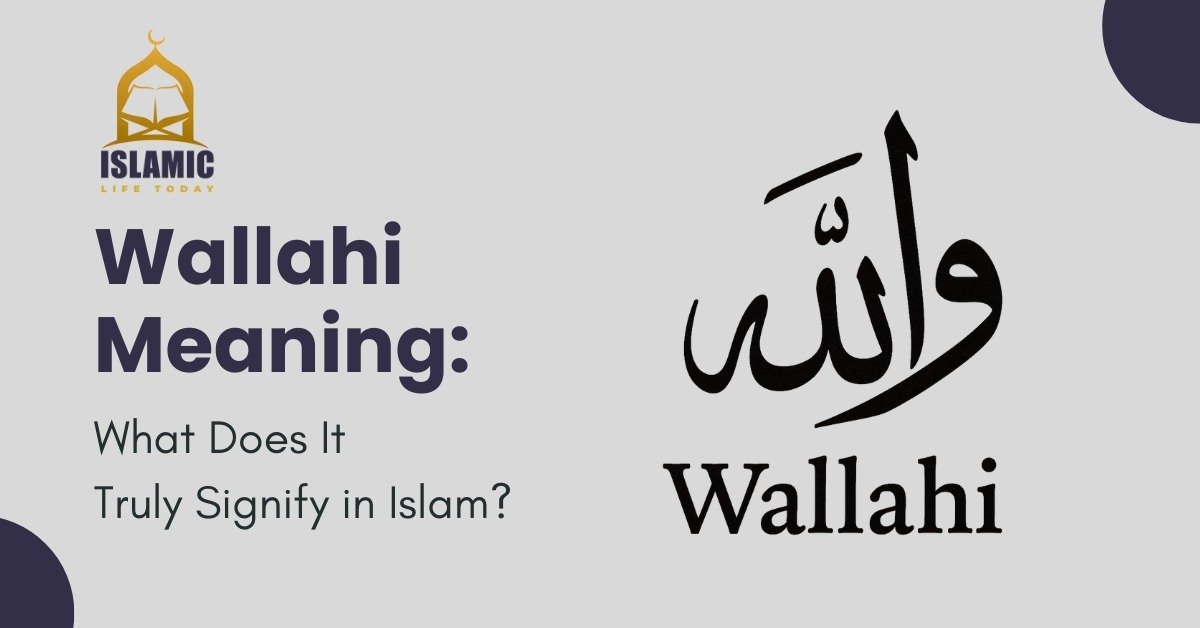
If you have ever interacted with Muslims or watched Islamic content online, you’ve probably heard the word “Wallahi”. It’s commonly used in conversations—just like people say “I swear” in English.
But here’s the truth:
When a Muslim says “Wallahi”, they are making a sacred oath by Allah (God).
This is not just a casual expression. In Islam, swearing by Allah holds serious weight, and carrying Allah’s name in something false or meaningless can bring sin.
So, what exactly is the wallahi meaning, and why is it so powerful in Islam?
Let’s explore.
Wallahi Meaning in Islam
Literal Translation
The word Wallahi comes from Arabic:
- “Wa” = By
- “Allahi” = Allah
So Wallahi means: “I swear by Allah.”
Spiritual Significance
When someone says Wallahi, they are making a declaration that what they say is the truth.
It’s an oath that connects speech directly to Allah, the Most High.
In Islam, this is not something to play with. You don’t say Wallahi for jokes, lies, or meaningless talk.
Think of it as writing a contract with your words—signed under Allah’s witness.
Wallahi in the Quran and Sunnah
The Quran and Sunnah emphasize that saying Wallahi is a sacred oath that must be spoken with truth, intention, and deep respect for Allah’s name.
Examples of Oaths in the Qur’an
Allah Himself takes oaths in the Qur’an to emphasize important lessons:
“By time, indeed mankind is in loss…”
— Surah Al-Asr (103:1–2)
“By the sun and its brightness…”
— Surah Ash-Shams (91:1)
These examples show that oaths are a powerful method to highlight truth.
Why Allah Takes Oaths
Allah takes oaths to:
- Grab attention
- Emphasize a truth
- Make humans reflect
But humans are only allowed to swear by Allah, not by anything else.
Hadith About Truthfulness and Oaths
Prophet Muhammad ﷺ said:
“Whoever swears, let him swear by Allah, or remain silent.”
— Sahih Bukhari
This hadith makes it crystal clear:
If you swear, it must be by Allah—nothing else.
No:
- “I swear on my mother”
- “I swear on my life”
- “I swear on my kids”
Islamic oaths are only Wallahi.
Types of Islamic Oaths
Islam classifies oaths (Yameen) into three types:
1. Rightful Oath (Yameen Mun’aqidah)
An intentional oath about something in the future.
Example:
“Wallahi I will stop gossiping.”
If you break it, you must pay kaffarah (expiation).
2. Mistaken Oath (Yameen Lagw)
When you say it by habit or slip of tongue.
Example:
“Wallahi, I think it’s 4 PM—wait no, it’s 3.”
There is no sin and no kaffarah.
3. False Oath (Yameen Ghamoos)
The worst one.
A person knowingly lies using Wallahi.
This is a major sin.
Islam says Allah will hold such a person accountable on the Day of Judgment.
Saying Wallahi Casually — A Serious Issue
Many people—especially in daily conversation—say “Wallahi” as casually as emojis.
Example:
- “Wallahi you won’t believe this!”
- “Wallahi I’m telling you the truth!”
But if used casually without intention, you risk turning a sacred oath into a habitual expression, which is discouraged.
When Saying Wallahi Becomes a Sin
- When used to lie intentionally
- When swearing about meaningless things
- When joking with Allah’s name
Punishment for Breaking Oath (Kaffarah)
If someone swears Wallahi and breaks it, Islam requires a kaffarah (penalty), which includes:
- Feeding 10 poor people
- Clothing 10 poor people
- Fasting 3 days (if unable to do the first two)
Islam takes truthfulness seriously—and using Allah’s name falsely is dangerous.
Cultural vs. Religious Use of Wallahi
In many countries (Middle East, Africa, South Asia), people say Wallahi casually.
But here’s the key difference:
| Religious Use | Cultural Use |
| Intentional oath before Allah | Habit/out of excitement |
| Must be truthful | Can be careless |
| Breaking oath demands Kaffarah | No awareness of the seriousness |
Just because a culture uses it casually doesn’t reduce its Islamic weight.
When It Is Allowed and When It Is Forbidden
✅ Halal Use of Wallahi
You can say Wallahi when:
- You are speaking truth
- You have certainty
- You are making a promise with intention
❌ Haram Use of Wallahi
Forbidden when:
- You lie intentionally
- You swear on things you don’t know
- You use it just to convince people
Example (haram):
“Wallahi I didn’t see anything”—while knowing you did.
Example (permissible):
“Wallahi, I will complete this task tomorrow.”
How to Use Wallahi Respectfully in Daily Life
Here’s how you can incorporate Wallahi correctly:
Formal Examples
| Situation | Proper Use |
| Confirming a truth | “Wallahi, this is the truth.” |
| Making promise | “Wallahi, I will try my best.” |
Avoid Saying Like This
| Situation | Casual Use (avoid) |
| Joking | “Wallahi bro, that pizza was from Jannah! |
| Exaggeration | “Wallahi I’ll never talk to you again!” |
Treat Wallahi like a spiritual signature, not a filler word.
Frequently Asked Questions (FAQs)
Yes. It’s allowed, but only when you swear truthfully and intentionally.
It means: “I swear by Allah.”
If said without intention or repeatedly as a habit, it is discouraged.
It becomes a major sin and requires kaffarah (penalty).
No. Islam allows swearing only by Allah, not by anything else.
Conclusion
The wallahi meaning is far deeper than an expression.
It is an oath. A declaration. A testimony before Allah.
When you say Wallahi, you place Allah as a witness to your words.
And if you lie while swearing by Allah, you’re not lying to people—you’re lying to the One who knows your heart.
Say it sincerely.
Honor its meaning.
Treat it with respect.
Because every time you say Wallahi…
your tongue writes, and Allah records.