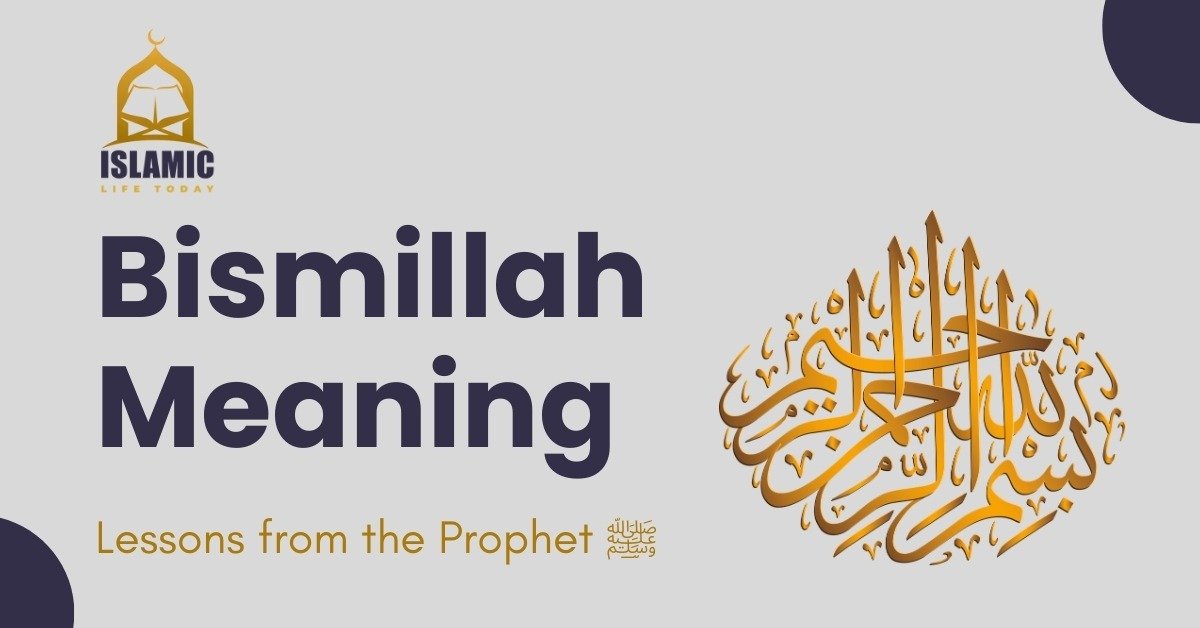
Have you ever stopped and truly thought about those three words you say every single day? “Bismillah ir-Rahman ir-Raheem.” You say it before eating, before leaving the house, before starting your work — but do you really know what it means? Do you understand why the Prophet ﷽ placed such enormous importance on these powerful words?
The bismillah meaning goes far deeper than most of us realize. It is not just an Arabic phrase we were taught as children. It is a declaration of complete dependence on Allah, a spiritual armor, and a key that unlocks the blessings in every single action we take. In this article, we are going to dive deep into the meaning of Bismillah, explore what the Prophet ﷽ taught us about it, and discover lessons that can truly transform the way you live your life. So, are you ready? Let’s begin — with Bismillah.
What Is Bismillah? Understanding the Basics
Before we can appreciate the lessons the Prophet ﷽ left us, we need to understand exactly what we are saying. The phrase “Bismillah ir-Rahman ir-Raheem” is one of the most recited sentences in the world. Billions of Muslims say it every single day, multiple times a day. But what does bismillah meaning actually cover?
Simply put, it translates to: “In the name of Allah, the Most Gracious, the Most Merciful.” But even this translation doesn’t do full justice to the weight of those Arabic words. Let’s break it down even further.
The Arabic Breakdown of Bismillah
In Arabic, every word carries layers of meaning that are often lost in translation. The word “Bi” means “with” or “in.” It implies association, reliance, and seeking assistance. “Ism” means “name” — but not in the ordinary sense. In Arabic tradition, a name represents the essence, identity, and attributes of something. So when you say “Bismi” — you are saying you are beginning this action in connection with, and through the power of, the one whose name you are about to mention.
Then comes “Allah” — the proper name of the Creator of the universe. Not just any God, not a title, but the one and only personal name of the Almighty. This is a name that carries infinite weight and infinite authority.
Bismillah Meaning in English — Word by Word
Let’s go even deeper into the bismillah meaning word by word. “Ar-Rahman” comes from the root “Rahma” — meaning mercy. But “Ar-Rahman” specifically refers to the vast, all-encompassing mercy that Allah showers upon all of His creation, believer and non-believer alike. Every breath you take right now is a gift of Ar-Rahman.
“Ar-Raheem,” on the other hand, is a more specific, personal mercy. This is the special mercy Allah reserves for the believers — the mercy that will carry them through the difficulties of this world and grant them ultimate success in the Hereafter. Think of it this way: Ar-Rahman is like the rain that falls on every field, while Ar-Raheem is the careful gardener who tends to a specific, precious garden with love and care.
So when you say Bismillah, you are reminding yourself that you are beginning your action in the name of a God who is overwhelmingly merciful, endlessly compassionate, and forever caring for you. Isn’t that a beautiful way to start anything?
The Prophet’s ﷺ Deep Connection with Bismillah
Now let’s talk about the man who made Bismillah a living, breathing practice — our beloved Prophet Muhammad ﷽. The Prophet ﷽ did not just recite Bismillah as a habit or a ritual. He understood the bismillah meaning at a soul level, and every time he said it, he was consciously connecting himself to Allah before taking any action.
The companions of the Prophet ﷽ observed him closely. They recorded his actions, his words, and his habits with extraordinary detail. And one of the most prominent patterns they noticed was how the Prophet ﷽ consistently began things with Bismillah. This was not accidental — it was intentional, purposeful, and deeply spiritual.
How the Prophet ﷺ Said Bismillah in Daily Life
The Sunnah of the Prophet ﷽ is filled with examples of when and how to say Bismillah. It was not reserved for prayer or formal worship. The Prophet ﷽ incorporated it into the most ordinary moments of his day — and that is precisely the lesson he was teaching us. Every moment of your life is an opportunity to connect with Allah.
Bismillah Before Eating — A Prophetic Sunnah
One of the most well-known lessons comes from a hadith narrated by Umar ibn Abi Salamah (may Allah be pleased with him). He reported that the Prophet ﷽ said: “O young boy, mention the name of Allah, eat with your right hand, and eat from what is nearest to you.” (Bukhari and Muslim). This simple instruction carries profound bismillah meaning. By saying Bismillah before eating, you transform a biological necessity into an act of worship. Your meal is no longer just fuel — it becomes a connection with your Creator.
Have you ever sat down for a meal and noticed how different it feels when you consciously say Bismillah with full awareness versus when you say it as a quick, automatic habit? The Prophet ﷽ wanted us to be present, to be aware, and to recognize that even our food is a mercy from Allah.
Bismillah Before Entering the Home
The Prophet ﷽ also taught us to say Bismillah when entering our homes. In a hadith narrated by Jabir (may Allah be pleased with him), the Prophet ﷽ said: “When a man enters his house and mentions the name of Allah upon entering and eating, Shaytan says to his followers: You have no place to spend the night and no dinner.” (Muslim). This is remarkable! Simply saying Bismillah when you walk through your door sends Shaytan away. Your home becomes a sanctuary of barakah (blessing) and protection.
Why Did Allah Begin the Quran with Bismillah?
Here is something worth reflecting on. The very first words of the Quran — the greatest book ever revealed to mankind — begin with Bismillah. This is not a coincidence. When Allah chose to communicate His final message to humanity, He began it with these words. That tells us something incredibly important about the bismillah meaning and its significance in Islamic life.
Some scholars have said that if you were to compress the entire Quran into one surah, it would be Surah Al-Fatihah. And if you compressed Al-Fatihah into one verse, it would be Bismillah ir-Rahman ir-Raheem. This is the depth and weight of what you say every day.
Bismillah as the Key to Every Good Deed
Think of Bismillah as a key. Just as a key unlocks a door, Bismillah unlocks the blessings and acceptance of your deeds. The Prophet ﷽ told us in a well-known hadith: “Every important matter that does not begin with the remembrance of Allah is cut off (from blessings) and is incomplete.” (Abu Dawud, Ibn Majah). This means that when you skip Bismillah, you are potentially cutting yourself off from divine barakah. You are starting your action with your own limited human power instead of tapping into the unlimited power of Allah.
Think about it this way — would you start a cross-country journey without fuel in your car? Of course not! Bismillah is the spiritual fuel for every action you take. Without it, you might still reach your destination, but you will miss out on the divine assistance and blessing that could have accompanied you on the way.
Key Lessons the Prophet ﷺ Taught About Bismillah
The Prophet ﷽ was the greatest teacher who ever walked this earth. And through his words and actions regarding Bismillah, he left us with timeless lessons that are just as relevant today as they were 1,400 years ago. Let’s explore these lessons one by one.
Lesson 1 — Always Begin with Allah’s Name
This is the most fundamental lesson embedded in the bismillah meaning. The Prophet ﷽ taught us through his consistent practice that no action — big or small — should begin without acknowledging Allah. Whether you are starting a business meeting, cooking dinner, writing an email, or beginning your morning routine, Bismillah is your first step.
This habit does something powerful to your psychology. Saying Bismillah serves as a powerful reminder of your true identity, your purpose in life, and your ultimate accountability to Allah. It humbles the heart, keeps the ego in check, and transforms your mindset from “I am doing this” to “I am doing this with Allah’s help and blessing.
Lesson 2 — Bismillah Brings Barakah (Blessings)
The Prophet ﷽ taught us that Bismillah brings barakah — divine blessing — into our actions. Barakah is one of those Arabic concepts that English cannot fully capture. It is not just “blessing” in the generic sense. Barakah is a divine increase that makes something grow beyond its apparent limits.
Even a small portion can create a big impact. A little food can nourish many, a brief moment can achieve remarkable results, and limited money can stretch in surprising ways—showing that even modest resources, when used wisely, can make a significant difference.This is barakah — and according to the Prophet ﷽, Bismillah is one of the keys that invites it. Families that say Bismillah together before meals often report a warmth and togetherness that goes beyond the food itself. That is barakah at work.
Lesson 3 — It Is a Shield Against Shaytan
We already mentioned the hadith about entering the home. But the protective power of Bismillah extends beyond that. The Prophet ﷽ taught that saying Bismillah before intimate relations between spouses protects any children born from that union from Shaytan’s influence. He also taught that saying Bismillah when angry helps control and extinguish that anger.
Why is Bismillah such a powerful shield? Think of it this way — Shaytan thrives in spaces where Allah is forgotten. The moment you say Bismillah, you are actively remembering Allah and inviting His presence into your action. And where the Light of Allah’s remembrance shines, the darkness of Shaytan cannot survive. It is that simple, and yet that profound.
Lesson 4 — Bismillah Completes Every Action
The Prophet ﷽ also addressed what to do if you forget to say Bismillah at the beginning of an action. He said: “If one of you forgets to mention the name of Allah at the beginning of his meal, let him say: ‘Bismillahi fi awwalihi wa akhirihi’ (In the name of Allah at its beginning and at its end).” (Abu Dawud, Tirmidhi). This beautiful flexibility shows us that Islam is a religion of mercy. Even in forgetting, there is a way to return to Allah. The bismillah meaning, at its core, is about continuous connection — not perfection.
Bismillah Meaning and Spiritual Power
Let us pause for a moment and think about what you are actually doing when you say Bismillah. When you say Bismillah, you invoke the name of the Creator of the heavens and the earth, the One who spoke “Be!” and brought everything into existence. You begin your actions under the protection and mercy of the Most Merciful and Most Compassionate.
This is not a small thing. This is an act of immense spiritual power. When understood correctly, the bismillah meaning should fill your heart with confidence, calm, and courage. You are not alone in anything you do. You are connected to Allah.
Ar-Rahman and Ar-Raheem — Two Attributes of Allah
The two divine names in Bismillah — Ar-Rahman and Ar-Raheem — are both derived from the same root word for mercy, but they describe different aspects of Allah’s care for His creation. The scholars explain that Ar-Rahman describes Allah’s mercy as it exists in this worldly life — vast, universal, available to every single human being regardless of their faith or deeds. The sunshine you enjoy, the air you breathe, the food you eat — all of this is Ar-Rahman.
Ar-Raheem, however, describes the special, focused mercy that Allah has prepared specifically for the believers in the next life. It is the mercy that will grant forgiveness, elevate ranks in Jannah, and make the Hereafter worth every single hardship of this world. So every time you say Bismillah, you are not just remembering two attributes of Allah — you are reminding yourself of His promise to care for you in both worlds.
What Happens When You Forget to Say Bismillah?
We are human, and we forget. This is one of the most reassuring aspects of the Prophet’s teachings on Bismillah — he acknowledged our imperfection and gave us a way forward. As mentioned above, saying “Bismillahi fi awwalihi wa akhirihi” mid-action covers the lapse and restores the blessing to what you are doing.
But the deeper lesson here is about awareness. The Prophet ﷽ wanted us to develop a habit of remembering Allah so naturally that forgetting Bismillah feels strange and uncomfortable. When that happens — when the absence of Bismillah feels wrong — you know you have truly internalized the bismillah meaning. That is the goal. Not robotic repetition, but living, breathing, conscious remembrance of Allah.
Bismillah for Children — Teaching the Next Generation
One of the most important investments Muslim parents can make is teaching their children the bismillah meaning from an early age. And the Prophet ﷽ showed us exactly how to do this. He taught children directly, kindly, and practically — as we saw in the hadith about the young boy and eating.
When children learn to say Bismillah, they are not just learning words. They are learning a worldview — one in which Allah is present in every moment, and every action is connected to a higher purpose. Parents who make Bismillah a family culture find that their children grow up with a natural God-consciousness that becomes the foundation of their character.
Make it fun, make it consistent, and make it meaningful. Explain to your children what they are saying. Ask them: “Who are we saying Bismillah to?” “What does Ar-Rahman mean?” These simple conversations plant seeds of deep faith that will last a lifetime.
Bismillah in the Quran — How Many Times Does It Appear?
Here is a fascinating fact that many Muslims do not know. Bismillah ir-Rahman ir-Raheem appears 114 times in the Quran — once at the beginning of 113 surahs (Surah At-Tawbah being the only exception) and once within Surah An-Naml (27:30), in the letter of Prophet Sulayman (Solomon) to the Queen of Sheba.
What is remarkable about this is that the number 114 is exactly equal to the number of surahs in the Quran. Coincidence? In Islam, we do not believe in coincidences when it comes to the Quran. This symmetry reinforces the bismillah meaning as something that permeates and underlies the entire revelation. Every surah, every chapter of divine guidance, is bookmarked by Allah’s most merciful names.
Common Mistakes Muslims Make With Bismillah
As much as Bismillah is central to Muslim life, there are several common mistakes that prevent us from fully benefiting from it. Let us be honest with ourselves for a moment.
The first mistake is saying Bismillah without understanding. When Bismillah becomes purely mechanical — a sound we make rather than a meaning we embody — we lose most of its spiritual benefit. The words are still good, but the transformation they are supposed to create in our hearts and actions is absent.
The second mistake is inconsistency. Some of us say Bismillah before meals but forget it before other actions. The Prophet ﷽ taught Bismillah as a comprehensive life principle, not a selective ritual. Every action deserves to be connected to Allah.
The third mistake is rushing. Bismillah should not be mumbled at lightning speed as a checkbox activity. Say it slowly. Say it with presence. Let the bismillah meaning land in your heart before you proceed with your action. You will be amazed at how different things feel when you approach them this way.
Frequently Asked Questions (FAQs)
The full bismillah meaning in English is: “In the name of Allah, the Most Gracious, the Most Merciful.” It is a declaration of beginning any action with the acknowledgment of Allah and His two attributes of mercy — Ar-Rahman (the all-encompassing mercy) and Ar-Raheem (the special mercy for believers).
The Prophet ﷽ said Bismillah before actions because he understood that all power, blessing, and success come from Allah alone. By saying Bismillah, he was seeking Allah’s help and barakah, protecting himself from Shaytan, and acknowledging his complete dependence on his Creator. It was not a ritual for him — it was a lived reality.
Forgetting to say Bismillah is not a sin — Islam recognizes human forgetfulness. However, it is recommended to say “Bismillahi fi awwalihi wa akhirihi” (In the name of Allah at its beginning and its end) if you remember mid-action. The Prophet ﷽ taught this specifically to help Muslims maintain connection with Allah even after forgetting.
Bismillah appears as the opening verse of 113 surahs. Surah At-Tawbah (Chapter 9) does not begin with Bismillah. However, Bismillah does appear within Surah An-Naml (27:30), bringing the total count to 114 — matching exactly the number of surahs in the Quran.
Both names come from the Arabic root for mercy (Rahma), but they describe different aspects of Allah’s mercy. Ar-Rahman refers to the universal, all-encompassing mercy that Allah extends to all of creation in this worldly life — sunlight, air, sustenance, and more. Ar-Raheem refers to the special, focused mercy Allah reserves for believers, particularly in the Hereafter, where it manifests as forgiveness, elevated ranks, and eternal reward.
Conclusion
Bismillah ir-Rahman ir-Raheem. These three words are your daily invitation to live in conscious connection with Allah. The bismillah meaning is not just a translation — it is a philosophy, a practice, and a profound spiritual gift that the Prophet ﷽ embedded into every moment of his life and invited us to do the same.
Every time you say Bismillah, you are following in the footsteps of the Prophet ﷽. You are acknowledging that you need Allah, that you rely on His mercy, and that you want His blessing on your actions. You are choosing not to be alone in anything you do.
The lessons from the Prophet ﷽ are clear: begin with Allah, invite His barakah, protect yourself from Shaytan, and teach your children to do the same. Islam is not just a religion of grand gestures and big moments — it is a faith that lives in the details of daily life, and Bismillah is perhaps the most powerful of those details.
So the next time you sit down to eat, walk through your door, start your workday, or begin anything at all — pause for a moment. Breathe. And say Bismillah like you mean it. Because you do.