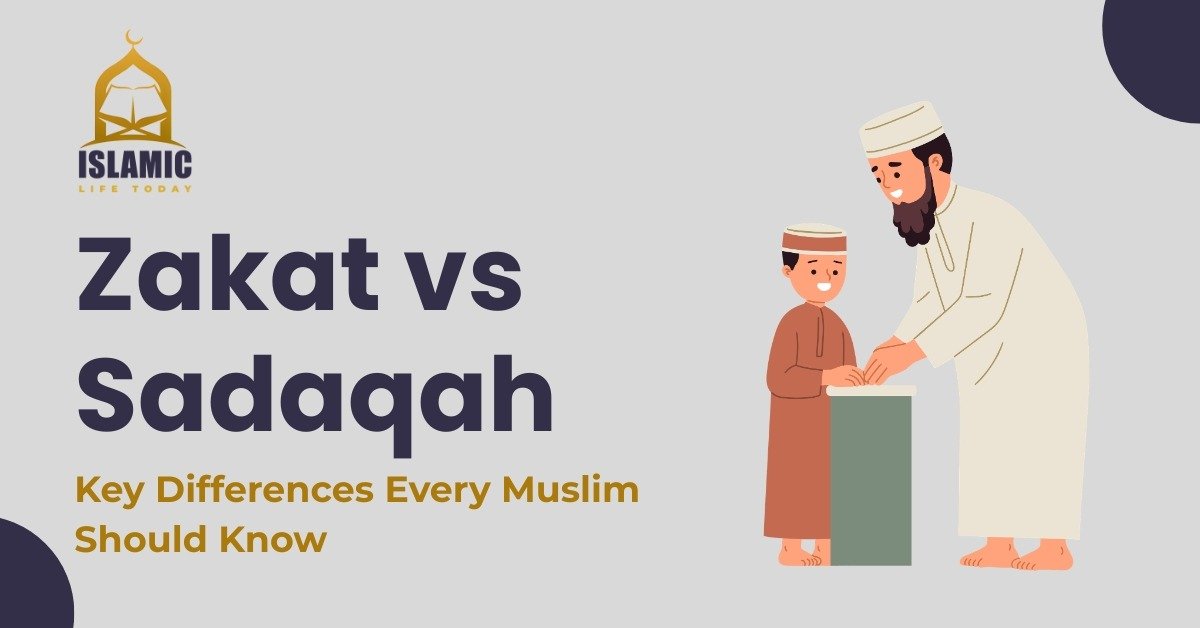
If you’ve ever paused before giving money to someone in need and wondered, “should this count as my Zakat, or is it separate?” — you’re not alone. Zakat and Sadaqah are two of the most common forms of charity in Islam, and while they’re often used interchangeably in everyday conversation, they are fundamentally different in obligation, calculation, recipients, and reward.
Understanding the zakat vs sadaqah difference isn’t just a matter of terminology. Fulfilling your religious obligation correctly, maximizing your charity’s impact, and calculating and distributing it properly all depend on giving in the right way. This guide breaks down everything you need to know in plain, practical terms.
Quick Answer: What’s the Core Difference?
Every eligible Muslim must pay Zakat annually by giving 2.5% of their qualifying wealth to the specific categories of recipients that Allah defines in the Quran. Sadaqah is voluntary charity — any amount, given at any time, to anyone in need, with no fixed formula or restrictions.
In short: Zakat is an obligation with rules. Sadaqah is generosity without limits.
What Is Zakat?
Zakat is one of the Five Pillars of Islam, making it a core obligation rather than an optional act of kindness. The word itself means “purification” or “growth” — the idea being that giving away a portion of your wealth purifies what remains and allows it to grow in blessing.
Key characteristics of Zakat
- Obligatory: Every Muslim who meets the wealth threshold (Nisab) must pay it.
- Fixed rate: Typically 2.5% of qualifying assets held for one lunar year.
- Specific recipients: The Quran (Surah At-Tawbah, 9:60) outlines eight categories of people eligible to receive Zakat, including the poor, the needy, those in debt, and travelers in need.
- Annual timing: Calculated once a year, often during Ramadan, based on wealth held for a full lunar year (Hawl).
- Applies to: Cash savings, gold and silver, business inventory, investments, and certain other assets — but not personal-use items like your home or car.
Who must pay Zakat?
You must pay Zakat when your qualifying wealth exceeds the Nisab threshold (approximately 85 grams of gold or 595 grams of silver, with gold being the more commonly used standard today) and remains above that threshold for one full lunar year.
What Is Sadaqah?
Sadaqah comes from a root word meaning “truthfulness” — the idea being that giving sadaqah is proof of the sincerity of your faith. Unlike Zakat, Sadaqah has no minimum amount, no fixed schedule, and no restrictions on who can receive it.
Key characteristics of Sadaqah
- Voluntary: There’s no obligation — it’s purely an act of generosity.
- No fixed amount: A single coin, a meal, or a large donation all count.
- Any recipient: Family, friends, strangers, or even animals — Sadaqah isn’t limited to the eight categories that apply to Zakat.
- Any time: Can be given daily, weekly, or whenever the opportunity arises.
- Broad definition: Sadaqah isn’t limited to money. A kind word, helping someone carry their bags, or even smiling at another person is considered Sadaqah in Islam.
Zakat vs Sadaqah: Side-by-Side Comparison
| Aspect | Zakat | Sadaqah |
| Obligation | Mandatory (Fard) | Voluntary (Nafl) |
| Amount | Fixed at 2.5% of qualifying wealth | Any amount, no limit |
| Timing | Once a year (after Nisab + Hawl met) | Anytime |
| Eligible recipients | 8 categories specified in the Quran | Anyone in need |
| Form | Primarily monetary/wealth-based | Money, time, kindness, or actions |
| Can it be given to relatives? | Generally not to immediate dependents | Yes, encouraged |
| Spiritual purpose | Purifies wealth, fulfills a pillar of Islam | Expresses generosity, earns extra reward |
Can Sadaqah Replace Zakat?
This is one of the most common questions — and the answer is no. Even if you give generously throughout the year in Sadaqah, it does not fulfill your Zakat obligation. Zakat is a distinct, calculated duty that must be paid separately, regardless of how much voluntary charity you’ve already given.
Think of it this way: Sadaqah is like a gift, while Zakat is like a debt you owe. You cannot cancel a specific debt you owe to someone by paying off other debts; you must settle each debt separately according to its own terms.
Why the Distinction Matters
Getting the zakat vs sadaqah difference right matters for a few practical reasons:
- Calculation accuracy: If you mistakenly count your everyday charitable giving toward your Zakat, you may end up underpaying what you actually owe.
- Recipient eligibility: Zakat can only go to the eight categories outlined in the Quran. If you give it to someone outside those categories, it may not count as valid Zakat — even if the cause is good.
- Record-keeping: Because Zakat is calculated annually based on wealth held for a lunar year, many Muslims track it separately from spontaneous Sadaqah donations for accuracy.
- Intentions (Niyyah): Both forms of charity require sincere intention, but Zakat specifically requires the intention to fulfill this religious obligation at the time of giving.
How to Calculate Your Zakat (Quick Overview)
While a full calculation depends on your specific assets, the basic formula is:
Total qualifying wealth held for one lunar year × 2.5% = Zakat due
Qualifying wealth typically includes:
- Cash in hand and in bank accounts
- Gold and silver (jewelry rules vary by scholarly opinion)
- Business stock and inventory
- Investments and shares
- Money owed to you that you expect to receive
You can generally deduct the debts you owe to others before calculating your final Zakat amount.
Practical Tips for Giving Both
- Set a Zakat date: Many Muslims calculate Zakat during Ramadan for ease of tracking and to maximize reward during a blessed month.
- Keep separate records: Track your Zakat-eligible wealth throughout the year so calculation is easier when the time comes.
- Don’t let Sadaqah replace Zakat — but don’t neglect it either: Even small, consistent Sadaqah (like a few coins a day) carries immense reward, as the Prophet Muhammad ﷺ emphasized that even a smile is a form of charity.
- Use reputable channels: Whether for Zakat or Sadaqah, give through organizations or individuals you trust to ensure your charity reaches those who truly need it.
Final Thoughts
Both Zakat and Sadaqah hold deep significance in Islam — one as an act of worship and obligation, the other as an expression of compassion and generosity. Knowing the zakat vs sadaqah difference ensures you fulfill your religious duties correctly while also embracing the spirit of giving that Islam encourages in everyday life.
Whether you pay the carefully calculated Zakat you owe each year or offer spontaneous Sadaqah to someone in need, you earn purification, blessings, and rewards in this life and the Hereafter.